How Modern Cricket Finds Its Next Big Stars: Cricket Talent Identification in 2026
Cricket's shift from a scout with a notebook to a genuinely high-tech talent identification system is one of the more interesting changes in the sport over the last decade.
How do teams actually find the next Virat Kohli or Jasprit Bumrah?
It's no longer just a matter of watching a talented teenager score runs or bowl fast. Modern cricket talent identification combines traditional scouting, performance data, video analysis, sports science, fitness testing, technology and mental-performance assessment. The goal isn't just finding the best player today it's identifying the players who have the skills, physical qualities, mentality and potential to become elite performers years from now.
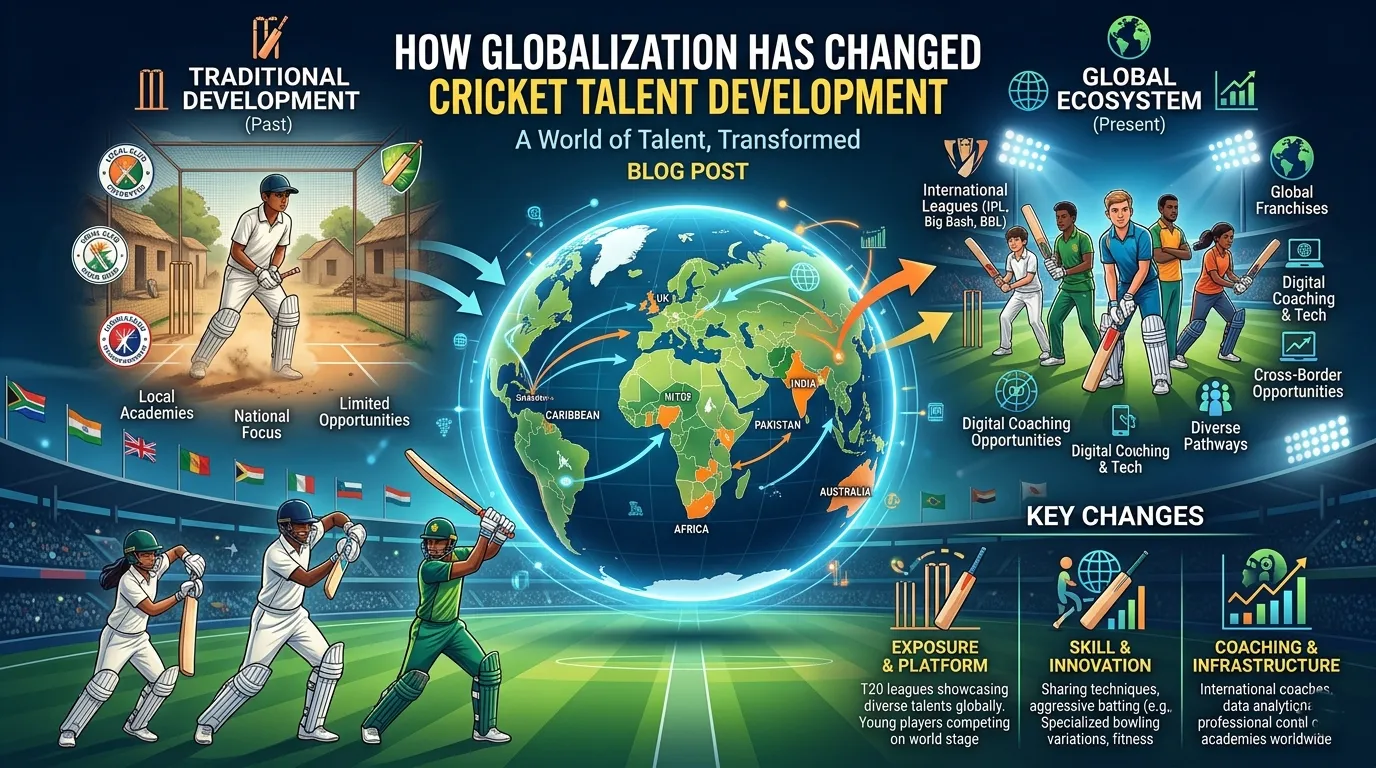
From village grounds and school tournaments through to domestic cricket, the IPL and high-performance centres, the pathway has become a lot more sophisticated. Here's how it works.
What talent identification actually means
Cricket talent identification is the process of finding players who show the technical, physical, tactical and psychological qualities needed to develop into high-level cricketers. That's different from simply picking the player with the best current stats.
A scout might look at a player's performance, but they're also asking how good the technique is, how quickly the player learns, whether they can adapt against stronger opposition, whether they have the physical attributes elite cricket demands, how they handle pressure, whether their weaknesses can be fixed, and how much room there is left to grow. That distinction matters talent identification looks at both performance and potential.
Research in this area has already shifted toward multi-factor models rather than relying on conventional scorecards alone, examining things like speed, agility, endurance, reaction time, motivation, stress response, decision-making, bowling accuracy, catching ability and hand-eye coordination.
Traditional scouting still matters
Before technology took over, scouts travelled across cities, districts and villages looking for raw talent watching local tournaments, school and college cricket, district matches, club cricket, domestic competitions, even informal games. The "eye test" sat at the centre of all of it.
A scout might notice something a scorecard never would. A young batter might have excellent balance, fast hands and an unusually early read on the length of the ball. A fast bowler might not be consistently accurate yet but could show exceptional pace, athleticism and a repeatable action. Those observations matter because young players are still developing.
A spreadsheet can tell a scout that a batter scored 70 off 45 balls. It can't tell you why. A scout watching in person might notice the batter adjusting quickly against spin, handling short bowling well, staying balanced while attacking, or improving their decisions the longer they face the same bowler. Likewise, a bowler's wicket count might look unremarkable on paper while a scout sees unusual pace or bounce that could translate into real effectiveness with better control.
So modern scouting isn't human judgement or data it's human judgement plus data plus technology, working together rather than replacing each other.
Where scouts actually look
Grassroots cricket remains the starting point for most players. Selectors search across school cricket, club cricket, district cricket, state age-group cricket, university cricket, domestic tournaments, academies and franchise trials.
Domestic tournaments matter in particular because they put players against stronger opposition in a more structured setting. In India, competitions like the Ranji Trophy, Syed Mushtaq Ali Trophy, Vijay Hazare Trophy, Under-19 cricket and various state-level events all give players a chance to establish themselves.
The bigger change is how wide the search has become. A talented player no longer has to come from Mumbai, Delhi or Bengaluru the search extends far beyond the traditional cricket centres.
What scouts look for depends on the role
Scouting isn't a single checklist applied to every player. A batter, fast bowler, spinner, wicketkeeper and fielder each get evaluated differently.
| Player Type | Technical | Physical | Tactical | Mental |
|---|---|---|---|---|
| Batter | Technique, shot selection, timing | Balance, coordination | Strike rotation, adaptation | Decision-making, temperament |
| Fast Bowler | Action, accuracy, release | Pace, strength, endurance | Variations, field awareness | Resilience, control |
| Spinner | Revolutions, flight, accuracy | Coordination, mobility | Drift, variation, attack plans | Patience, tactical awareness |
| Wicketkeeper | Glovework, footwork | Agility, reaction speed | Positioning | Concentration |
| Fielder | Catching, throwing | Speed, acceleration | Anticipation | Concentration, pressure control |
There's no single definition of cricket talent. A player's value depends on what they can do, how consistently they can do it, and how much room they have left to develop.
Current performance vs future potential
One of the hardest problems in talent identification is separating what a player is doing right now from what they might become.
Take two 17-year-old batters. One scores heavily against moderate opposition. The other scores less but faces tougher bowling, adapts quickly, and shows better technique. Which one has more potential? Runs alone can't answer that.
Scouts weigh current performance against age, competition level, technical ability, physical development, decision-making, learning speed, adaptability, mental resilience and overall trajectory. A young player might not dominate immediately simply because they're still physically developing or adjusting to a higher level. Meanwhile, a player can put up outstanding youth numbers without ever becoming an elite senior player.
Talent identification is really a prediction problem. The question isn't just who's best right now it's who has the characteristics and development potential to become exceptional.
Technology and data analytics
Modern cricket has become heavily data-driven. Instead of simply recording 82 runs off 54 balls, analysts can break an innings down into far smaller pieces.
On the batting side, teams look at strike rate, boundary percentage, dot-ball percentage, powerplay and middle-over and death-over performance, output against pace versus spin, performance against left-arm or right-arm bowlers, chasing form, and how a player performs under pressure specifically. On the bowling side: economy rate, dot-ball percentage, wickets, boundary percentage conceded, bowling speed, length distribution, release point, and control across different phases of an innings against different types of batters. Fielding gets the same treatment now too catching, throwing accuracy, reaction time, movement, ground-fielding efficiency, positioning and distance covered.
All of this builds a far more detailed picture of a player than a traditional scorecard ever could.
Video analysis
Video has become one of the most useful tools in modern scouting. Platforms like Dartfish, Hudl and Kinovea let coaches break down movement and technique frame by frame bat movement, footwork, head position, bowling action, release point, seam position, body alignment, fielding technique, reaction patterns.
What makes video especially useful is comparison. A coach can review the same batter against fast bowling, spin, short balls, full balls, and different match situations side by side. The scorecard shows the outcome; video shows the process behind it.
Predictive analytics and AI
This is where talent identification is moving well beyond traditional statistics. Teams can use large datasets to spot patterns an individual observer might miss which young players are outperforming their age group, which are improving fastest, which stats tend to translate to higher levels, which weaknesses are actually limiting a player, and which players might be undervalued or fit a specific tactical need.
Cricket research is already testing machine-learning approaches here. A 2026 study looked at machine learning alongside virtual reality and perceptual-cognitive assessment for batting talent identification, which gives a sense of how far the field has moved past conventional stats.
But AI doesn't magically discover a superstar on its own. The quality of any prediction still depends on data quality, model quality, cricket expertise and human evaluation working together a model trained on poor or biased data will produce poor recommendations. So the likely future isn't AI replacing scouts, it's AI helping scouts process more information and make better-informed calls.
Player tracking and sensors
A modern cricketer generates data well beyond what shows up on a scorecard. Tracking systems can capture player movement, ball trajectory and speed, release position, running and acceleration patterns, workload, repeated high-intensity effort, and technical movement more broadly. AI-powered tracking is now starting to reach grassroots and trial environments too, so this kind of analysis isn't limited to international cricket anymore.
That matters because a young player's potential isn't always obvious from the stats alone tracking data can reveal how efficiently someone moves, how consistently they execute a skill, and how their physical workload shifts over time.
Sports science and wearables
Fitness now sits at the centre of elite cricket. A talented player has to be able to perform at a high level repeatedly while managing the physical demands of a packed modern schedule.
Teams use GPS trackers, heart-rate monitors, load-monitoring systems, movement sensors and recovery measurements to understand training load, match workload, running demands, recovery, fatigue, physical development and injury risk. Fitness testing in elite cricket goes well beyond a single test it covers endurance, speed, acceleration, strength, mobility and the ability to repeat high-intensity actions. The goal isn't finding the fittest player; it's understanding whether a player's physical profile can hold up to elite-level demands.
Mental strength
Modern cricket doesn't just test skill it tests the mind. A technically excellent player can still struggle if they can't handle pressure, so teams also assess pressure handling, decision-making, emotional control, concentration, confidence, resilience, adaptability, match temperament and how a player responds to failure.
That matters more than ever in professional cricket, where a player deals with selection pressure, huge crowds, social media scrutiny, contract uncertainty, competition for places, international expectations, and the possibility of failing in front of millions of people. High-performance programmes increasingly treat technical and mental development as connected rather than separate a player who bounces back quickly from failure can have a very different long-term trajectory than someone with similar technical ability who struggles psychologically.
Academies in India
India's talent pathway reaches well beyond the international team. Academies and high-performance centres give promising players a structured environment to develop.
One of the most important is the BCCI Centre of Excellence in Bengaluru, formerly the National Cricket Academy, which provides infrastructure for advanced training, sports science, medical support, rehabilitation, fitness and broader high-performance development. It's really the modern version of an idea that's existed in Indian cricket for years: find promising players early, then give them the environment to actually develop.
The Talent Resource Development Wing
India has been experimenting with organised talent identification for a couple of decades now. The Talent Resource Development Wing (TRDW) was set up by the BCCI in the early 2000s specifically to push talent identification beyond the traditional cricket centres, on the basic idea that elite talent doesn't only exist where elite infrastructure already does.
Scouts could search smaller towns and less traditional cricket regions using defined attributes rather than leaning entirely on reputation. The programme became associated with identifying players including MS Dhoni, Suresh Raina and Irfan Pathan. The individual names matter less than the broader lesson: talent identification has to go looking for talent. A player can't be selected if the system never sees them in the first place.
From grassroots to international cricket
The modern pathway works more like an ecosystem than a single selection event:
                    GRASSROOTS
                        │
          ┌─────────────┴─────────────┐
          │                           │
      School/Club                 Local Cricket
          │                           │
          └─────────────┬─────────────┘
                        ↓
                District / State
                        ↓
                 Age-Group Cricket
                        ↓
                    Academy
                        ↓
              Domestic Cricket
          ┌─────────────┴─────────────┐
          │                           │
     Ranji Trophy              Vijay Hazare /
                              Syed Mushtaq Ali
          │                           │
          └─────────────┬─────────────┘
                        ↓
                  IPL / Franchise
                        ↓
                 India A / Pathway
                        ↓
               INTERNATIONAL CRICKET
Not every player follows this exact route some emerge through different competitions, academies or franchise systems but the underlying principle holds: more levels mean more chances to identify, test and develop talent.
The IPL as talent launchpad
The IPL has changed the economics and visibility of cricket talent completely. Before the IPL, an unknown domestic player generally had to establish himself through years of domestic cricket before getting any real attention. Now a single breakout franchise season can transform a career almost overnight.
IPL franchises run extensive scouting networks, analysing domestic stats, video, player tracking, fitness, matchups, role suitability, performance trends and opposition quality, alongside trials and ongoing monitoring across domestic competitions. The IPL works as a talent accelerator as much as a competition a young player can go from relative obscurity to national attention off the back of a handful of standout performances.
But one good IPL game doesn't prove long-term elite potential on its own. Franchises still have to work out whether the performance is repeatable, transferable and sustainable.
What makes a player attractive to an IPL scout
A franchise doesn't need eleven superstars it needs players who solve specific problems. One team might need a powerplay hitter, another a left-arm seamer, a death-over specialist, a wrist-spinner, a finisher, a domestic Indian wicketkeeper, or a flexible all-rounder.
That changes the question scouts ask. Instead of "who is the best player," it becomes "which player best fits the role we need." That's where data and traditional scouting complement each other data can identify who performs a given role well, and scouts can then judge whether the player's technique, mentality and development potential actually suit the franchise.
Why good stats don't always mean elite potential
Statistics are powerful, but they're not perfect. A young player might dominate simply because the competition is weaker, the conditions favour their technique, they're more physically developed than their peers, their role gives them favourable opportunities, or they haven't faced elite bowling yet.
The reverse happens too a genuinely talented young player can post ordinary numbers while adapting to a higher level, getting limited opportunities on their team, facing tougher opposition, going through physical development, or being asked to fill an unfamiliar role. Talent identification can't be reduced to a leaderboard. Numbers identify patterns; context explains them.
Why the modern system works better
| Traditional Approach | Modern Approach |
|---|---|
| Scout observation | Scout + data |
| Match scorecard | Detailed performance data |
| Limited video | Extensive video analysis |
| Basic fitness testing | Sports science + workload monitoring |
| Local scouting | Wider talent networks |
| Personal judgement | Judgement supported by evidence |
| Limited tracking | Player and ball tracking |
| Reactive selection | Potential and development analysis |
| Few data points | Multiple performance indicators |
The modern approach doesn't remove human judgement from the process it just gives that judgement a lot more to work with.
The challenge of scouting bias
Technology can reduce some forms of bias, but it doesn't eliminate it automatically. A scout might favour a familiar playing style, a famous academy, a particular region, a well-known coach, or a player with obviously impressive physical attributes.
Data can help push back against those assumptions if an unknown player keeps producing strong numbers against good opposition, it gets harder to overlook them. But algorithms can inherit bias from their training data too, which is why the best system still combines objective data, expert observation, context and repeated evaluation rather than leaning on any one of them alone.
Where this is heading: continuous talent intelligence
Maybe the biggest shift in cricket scouting is that it's becoming less of a single event. Instead of watch player, then select player, the process now looks more like:
IDENTIFY
   ↓
MEASURE
   ↓
ANALYSE
   ↓
DEVELOP
   ↓
REASSESS
   ↓
COMPARE
   ↓
SELECT
   ↓
CONTINUE MONITORING
A player's development can now be tracked over months and years who's improving fastest, who's developing physically, who's fixing technical weaknesses, who adapts to stronger opposition, who handles rising pressure, who holds their form as workload increases. The question shifts from "is this player talented" to "how is this player's talent developing," which is a much more useful way to think about scouting going forward.
Frequently asked questions
How do cricket teams find young talent? Through grassroots scouting, school and club cricket, domestic competitions, academies, video analysis, statistics, fitness testing, trials, and increasingly technology and data analytics.
What is talent identification in cricket? Evaluating a player's technical, physical, tactical and psychological qualities to judge both current ability and future potential.
Do scouts still use the eye test? Yes human observation still catches technical, tactical and behavioural qualities that statistics don't fully capture.
How is data used in cricket scouting? By breaking down batting, bowling and fielding performance across phase, opposition, match situation and role to spot strengths, weaknesses and trends.
Is AI used to find cricket players? Increasingly, yes AI and machine-learning research is being applied to performance and talent identification, analysing large amounts of data to spot patterns that are hard to catch manually.
How does the IPL help young cricketers? It exposes emerging players to elite competition, experienced teammates, professional coaching, advanced facilities and a highly visible platform that can accelerate a career quickly.
What qualities do scouts look for? Technical ability, physical qualities, tactical understanding, decision-making, adaptability, mental resilience, consistency and long-term development potential.
Can a player be talented without great stats? Yes stats reflect performance in a specific context, and scouts also weigh technique, opposition quality, physical development, adaptability and potential.
What is the BCCI Centre of Excellence? A major high-performance facility in Bengaluru, formerly the National Cricket Academy, supporting cricket training, sports science, medical care, rehabilitation and player development.
Why modern talent identification works
Cricket has come a long way from the days when finding a future star depended almost entirely on one scout watching one match. The old system still matters the trained eye, the years of experience but the modern system has added something powerful: more information.
A scout watches the player. A coach studies the technique. An analyst goes through the statistics. A video system reveals movement patterns. A sports scientist assesses physical development. A psychologist evaluates mental performance. An AI model processes large datasets and flags patterns. An academy works on the player's weaknesses. A domestic competition tests them against tougher opposition. And the IPL offers a pathway to the biggest stage of all.
From village grounds to high-performance centres, from handwritten scouting notes to AI-assisted analysis, cricket talent identification has turned into a full ecosystem. The next Kohli or Bumrah might not come from the most famous academy or the biggest city they might come from somewhere the old system would have overlooked entirely. Technology can widen the search, but talent still has to prove itself. And the next cricket superstar may already be out there on some small ground, waiting for the modern system to notice.