How Globalization Has Changed Cricket Talent Development Forever
Not long ago a talented young cricketer in a small Indian town had one path to the national team — local club cricket, state trials, domestic tournaments, and hoping the right selector was watching on the right day. Extraordinary talent was sometimes missed simply because the system for finding it was limited by geography and resources.
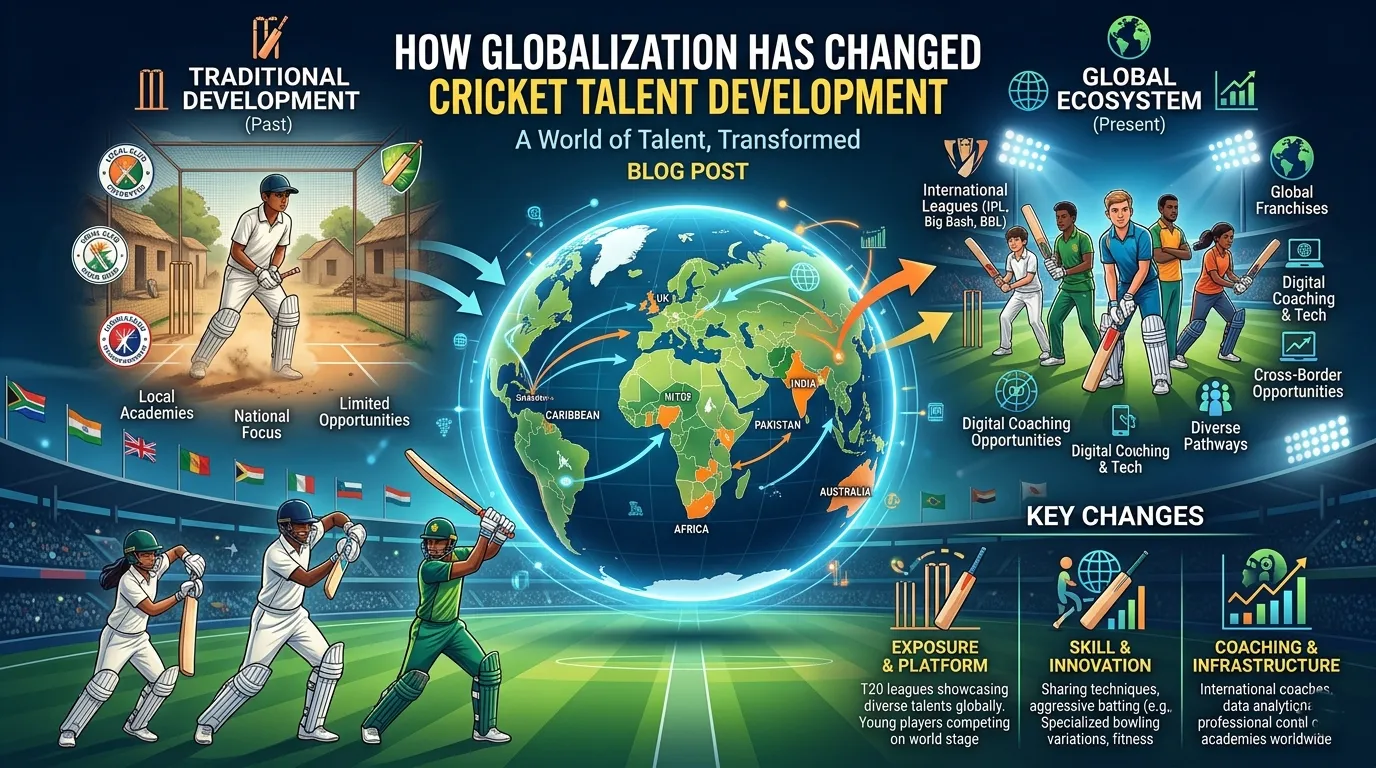
That world no longer exists. Globalization has fundamentally restructured how cricket talent is identified, developed, and given pathways to the highest level. The combination of global T20 leagues, technology, expanding academies, and specialized coaching has made cricket's talent development system more comprehensive, more accessible, and more effective than at any previous point in the sport's history.
Global T20 Leagues: The World's Biggest Talent Platform
The explosion of T20 leagues across the world has done more to democratize cricket talent development than any other single change in the modern game.
The IPL transformed the model first and most dramatically. Since its launch in 2008 it has provided Indian domestic players with a platform to compete against the world's best in front of massive audiences and under genuine pressure. A young spinner from Tamil Nadu who performs well in the IPL is seen by millions of viewers, evaluated by national selectors, and measured directly against international-quality batters — an exposure that the domestic circuit alone could never provide at the same intensity.
Other leagues have extended this model globally. Australia's Big Bash League, the Caribbean Premier League, South Africa's SA20, and the UAE's ILT20 have each created regional talent platforms that serve their local player bases in comparable ways. A young fast bowler from the UAE who plays in the ILT20 alongside experienced internationals develops faster than the same player training exclusively in domestic cricket. They face real pressure, receive direct feedback from elite teammates, and build the match-hardened experience that transforms technical ability into international-level performance.
The financial dimension matters equally. Before the league cricket era, professional cricket provided limited financial security for all but the most established internationals. Young players from lower-income backgrounds had to weigh the uncertain financial prospects of a cricket career against more stable alternatives. League cricket has changed that calculation significantly. A player who performs well at IPL level can earn in weeks what previous generations earned across entire seasons. Cricket has become a genuinely viable career path for talented young players in a way it simply was not two decades ago.
Technology: The New Foundation of Talent Identification
The transformation in how technology is used across cricket development is one of the most significant and least publicly visible changes in how the modern game produces players.
Video analysis that would have required specialist equipment and significant expense twenty years ago is now available to coaches at every level through standard software on standard devices. A batting coach can analyse a young player's technique frame by frame, identify a specific flaw in foot movement or head position, and show the player exactly what is happening in a way that verbal description alone cannot achieve. The precision this enables in technical correction has measurably accelerated development timelines for players who receive quality coaching.
Wearable technology tracks physical data across training and matches — heart rate, movement patterns, load accumulation, and recovery metrics — that coaches use to personalise training programmes and manage injury risk. A fast bowler whose wearable data shows accumulating back load across a training week can have their programme adjusted before injury occurs rather than after. This proactive injury management has extended careers and kept more talented players available for more cricket than previous generations experienced.
Data analytics has transformed talent identification by making it possible to evaluate players against specific performance metrics rather than relying solely on selector observation and reputation. A young batter whose control percentage and dot ball tolerance metrics suggest elite Test potential can be identified from data before their reputation has spread through the traditional word-of-mouth channels that previously governed selection pathways. This makes talent identification more systematic and less dependent on a player having the right connections or being seen by the right person at the right moment.
Virtual Reality is the most recent technological addition to cricket development programmes. VR environments allow players to face simulated versions of specific bowlers in specific conditions — practising against a left-arm spinner on a turning pitch, or facing a high-pace right-arm bowler under floodlights — without the physical load of real match practice. The skill transfer from VR environments to actual match conditions is still being studied, but the ability to accumulate repetitions in specific scenarios without physical strain represents a genuinely new development tool.
Cricket Academies: From Regional to Global
The academy model that has always been central to Indian cricket development has expanded globally in ways that reflect both the sport's growing international footprint and the communities of cricket fans that globalization has spread around the world.
Traditional cricket nations have upgraded and expanded their academy structures significantly. In India the network of academies linked to state boards, IPL franchises, and private cricket businesses now reaches into communities that previously had limited access to structured coaching. The BCCI's National Cricket Academy in Bengaluru has become one of the most sophisticated player development facilities in world cricket, providing rehabilitation, technical development, and performance analysis capabilities that support players across all levels of the national system.
The genuinely new development is academy expansion into non-traditional cricket markets. Academies have opened across the United States, the UAE, Japan, Germany, and other countries where cricket has historically had minimal presence. These academies are often community-driven, emerging from diaspora populations who brought their love of the game to new countries and created structured environments for their children to learn it properly.
The ICC Global Cricket Academy in Dubai exemplifies the most ambitious version of this model. Its facility imports soil from different countries to create pitch conditions that replicate the surfaces players will face in England, Asia, and Australia — allowing players from any background to prepare for specific international environments without travelling to those countries. This kind of infrastructure was unimaginable for any previous generation of cricketers outside the wealthiest national boards.
Some individual player academies have also developed global reach. Initiatives linked to established international players have created development programmes that operate across multiple countries, bringing the methods and standards of elite cricket to aspiring players in markets where those standards were previously inaccessible.
Coaching: The Shift to a Multi-Disciplinary Approach
The model of one coach managing all aspects of a player's development has been replaced at elite levels by specialist teams that address each component of performance separately and in coordination.
Modern elite cricket programmes include batting coaches, bowling coaches, fielding coaches, strength and conditioning specialists, physiotherapists, nutritionists, and increasingly, sports psychologists and mental performance coaches. Each specialist brings depth to their specific area that no single generalist coach could match across all areas simultaneously. The coordination between these specialists — ensuring that the physical loading from strength training does not compromise the technical work happening in nets, or that the mental skills being developed are reinforced across all training environments — represents a level of programme design sophistication that is genuinely new in cricket.
Sports science integration has made the physical preparation component more precise than previous generations experienced. Understanding how a bowling action distributes load across the body allows conditioning coaches to build specific strength in the muscles and joints most exposed to injury risk. Understanding how batting requires different physical qualities from fielding allows training programmes to develop all required qualities without compromising any of them.
Mental performance coaching has moved from the periphery to the centre of elite cricket development. The psychological demands of international cricket — sustaining concentration across five days, resetting after failures in front of millions, managing the pressure of national expectation — are treated as trainable skills rather than fixed personality traits. Young players in modern development programmes receive specific mental skills training long before they face the pressures of international cricket, arriving at the top level with psychological tools that previous generations had to develop reactively under match pressure.
Online coaching platforms have extended quality coaching access to grassroots players in remote areas who previously had no access to specialist instruction. A talented young cricketer in a rural area with internet access can now receive technical coaching from qualified specialists through video platforms that would have been unimaginable even fifteen years ago. This democratization of coaching quality is gradually reducing the development gap between players from well-resourced urban environments and those from less-resourced backgrounds.
What Globalization Has Created for the Next Generation
The cumulative effect of these changes is a cricket development landscape that is dramatically more accessible, more precise, and more supportive than anything previous generations experienced.
The pathway from raw talent to international cricket is clearer than it has ever been. A talented young player who accesses good coaching, performs well in domestic cricket, attracts IPL attention, and develops their game through the technology and specialist support now available has a genuine pathway to international cricket regardless of where in India they come from or what their financial background is.
The exposure that global cricket provides is equally transformative beyond pure cricket development. Young players who participate in leagues, academies, or touring programmes across different countries develop cultural adaptability, communication skills, and a global perspective that serves them throughout their lives regardless of how far their cricket careers progress. The life skills that structured team sport provides — managing pressure, working within teams, handling failure and success gracefully — are amplified when that sport is played in genuinely global contexts.
The challenges that remain are real. Infrastructure development in genuinely new cricket markets requires sustained investment. Balancing the financial incentives of league cricket with the development needs of the longer formats requires ongoing management. Ensuring that commercial growth does not distort the fundamental values of the game requires vigilance from cricket's administrators.
But the direction of travel is clear and positive. Cricket is genuinely global now in its talent development infrastructure in a way it has never been before, and the players emerging from that global system are better prepared, better coached, and better supported than any generation that came before them.
FAQ: Globalization and Cricket Talent Development
How has globalization changed cricket talent development? Globalization has transformed cricket talent development through the expansion of global T20 leagues providing competitive exposure, technology enabling precise talent identification and coaching, academies expanding into new markets worldwide, and multi-disciplinary coaching approaches replacing single-coach development models.
How do T20 leagues help develop cricket talent? T20 leagues like the IPL provide young players with direct competitive exposure against world-class opposition, financial security that makes cricket a viable career, and visibility to national selectors that domestic cricket alone cannot match at the same intensity.
What technology is used in modern cricket development? Modern cricket development uses video analysis software, wearable fitness tracking devices, data analytics for performance measurement, biomechanical coaching tools, and increasingly Virtual Reality environments for scenario-specific skill practice.
How have cricket academies changed globally? Cricket academies have expanded from traditional cricket nations into new markets including the USA, UAE, Japan, and Germany, driven by diaspora communities and the growing global popularity of T20 cricket. Facilities now include pitch conditions replicating multiple international environments and specialist coaching across all performance areas.
Why is mental coaching now important in cricket development? Mental performance coaching is now central to cricket development because psychological skills — concentration management, failure processing, pressure handling — are recognised as trainable capabilities rather than fixed personality traits, and players who develop them early perform more consistently at the highest level.