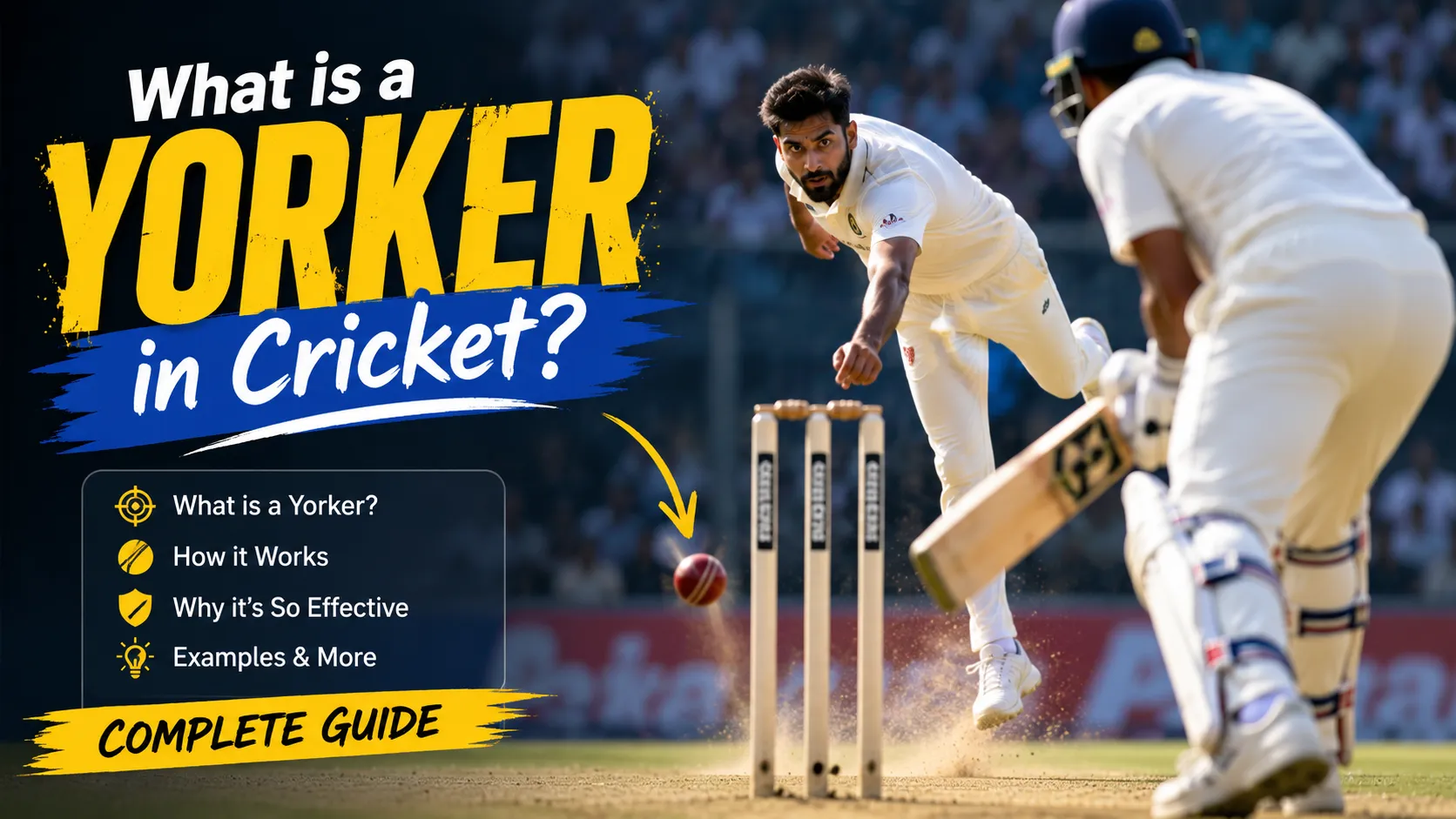
What is a Yorker in Cricket? The Complete Guide to This Deadly Delivery
The bowler comes in at full pace. The crowd holds its breath in the final overs. The ball arrives so fast and so low it seems to appear at the batter's feet from nowhere. Stumps shatter, or the batter is left frozen, bat jammed down in desperation.
That delivery is a yorker one of cricket's most feared and most technically demanding deliveries. Understanding what makes it so effective, how bowlers actually execute it, and why some of the greatest fast bowlers in history built entire careers around mastering it gives you a genuinely deeper appreciation of cricket's most dramatic moments.
What a Yorker Actually Is
A yorker is a delivery bowled to land at or extremely close to the batter's feet, typically targeting the base of the stumps or the popping crease line directly beneath the bat. Rather than pitching at a length that allows the batter time to judge bounce and trajectory, a yorker arrives so low and so fast that the batter has almost no margin for error in their response.
The precision required is extraordinary. The target area for a perfect yorker is a matter of inches landing too short turns it into a regular good-length delivery that batters handle comfortably, while landing too full turns it into a full toss that is among the easiest deliveries in cricket to hit for a boundary. Between those two failure modes lies a narrow window that elite fast bowlers train for years to consistently hit.
Why a Yorker Is So Difficult to Play
The fundamental problem a yorker creates for a batter is the complete absence of room to manoeuvre the bat effectively. Most cricket shots require the batter to get underneath the ball or behind it with enough clearance to generate a controlled swing. A delivery arriving at the base of the stumps leaves no such space.
Batters facing a yorker are forced into what is commonly called digging it out a defensive, almost desperate jam of the bat down toward the ball's landing point, attempting simply to make contact and prevent the ball from hitting the stumps or the pads in front of them. There is no opportunity to play an attacking shot. The best a batter can typically hope for from a perfectly executed yorker is to survive the delivery without losing their wicket.
The two primary dismissal outcomes from a successful yorker are bowled the ball getting through the bat and pad combination to hit the stumps directly and lbw, where the ball strikes the pad in line with the stumps before the bat can intervene. Both outcomes are common enough that yorkers remain one of the most reliable wicket-taking deliveries in a fast bowler's arsenal.
This combination of defensive necessity and dismissal risk is precisely why yorkers are so valuable in the death overs of limited overs cricket. When batters are attempting to score boundaries off every delivery to maximise their total, a well-executed yorker takes the attacking option away entirely and simultaneously threatens to end their innings.
How Bowlers Actually Execute a Yorker
Bowling a yorker consistently is widely considered one of the hardest specific skills in fast bowling, requiring a combination of precise targeting, technical execution, and extensive repetition.
Targeting precision is the foundation. Bowlers train specifically to hit the base of the stumps or the popping crease area, often using physical markers in practice a shoe, a cone, or a specific spot drawn on the pitch and bowling repeatedly at that exact target until the muscle memory for the required trajectory becomes consistent under match pressure.
The release point for a yorker differs from a standard delivery. The ball needs to be released slightly earlier in the bowling action than a good-length delivery, with the bowling hand positioned more vertically at the point of release. This earlier release combined with a strong, upright wrist position is what produces the steep, full trajectory that lands at the batter's feet rather than bouncing further up the pitch.
Maintaining bowling action consistency under the pressure of attempting this precise delivery is the hardest part. A fast bowler's normal action, repeated thousands of times in training, is what generates their typical good-length delivery almost automatically. Adjusting that action specifically for a yorker while maintaining the same pace and the same disguise so the batter cannot read the change from the bowler's approach requires extensive specific practice separate from general fast bowling training.
The margin for error explains why even elite fast bowlers occasionally miss their intended yorker. A release fractionally early produces a full toss. A release fractionally late produces a low full toss or half-volley. Both are significantly easier for batters to score from, which is why yorker execution under pressure particularly in the chaotic final overs of a T20 run chase separates the very best death bowlers from merely good ones.
Where the Name Yorker Comes From
The origin of the term yorker remains genuinely debated among cricket historians, though one theory dominates.
The most widely accepted explanation traces the name to Yorkshire, the famous English cricketing county known historically for producing skilled fast bowlers. The theory holds that bowlers from Yorkshire became particularly associated with this style of delivery, and the name simply attached itself to the ball type over time through that regional association.
An alternative theory connects the term to an older English expression to pull Yorkshire on someone, meaning to trick or deceive them. Under this explanation the name reflects the deceptive nature of a well-disguised yorker, which tricks the batter into expecting a normal-length delivery before revealing itself as something entirely different at the last moment.
Neither theory has definitive historical documentation confirming it as the sole origin, and cricket historians generally acknowledge both as plausible contributing explanations for how the term entered the game's vocabulary.
The Different Types of Yorker
Fast bowlers have developed several variations of the yorker, each designed to create a specific tactical advantage or additional layer of deception.
Inswinging Yorker
This variation combines the standard yorker's full length with inward swing toward the batter's pads as the ball travels through the air. For a right-handed batter facing a right-arm bowler, the inswinging yorker threatens both the stumps directly and an lbw dismissal simultaneously, because the ball is moving into the batter's body while also arriving at their feet. This combination makes it one of the most dangerous deliveries in fast bowling, and its destructive effect on a batter's feet and toes has earned it colourful nicknames across cricket-playing countries toe-crusher, sandshoe crusher, and nail-breaker among them.
Wide Yorker
Rather than targeting the stumps directly, a wide yorker is bowled full and fast but well outside off stump, beyond the batter's comfortable reach. The objective here is usually not a direct wicket but run prevention forcing the batter to stretch awkwardly for a delivery they cannot access with their normal technique, typically producing a dot ball or a mistimed, low-percentage shot. This variation is particularly common in T20 death overs when containing the scoring rate is as valuable as taking a wicket.
Slower Yorker or Knuckle Yorker
This variation adds deception through pace rather than line or swing. The bowler maintains the same full-pace bowling action and arm speed that batters associate with a fast yorker but releases the ball with reduced pace, often using a knuckle ball grip where the ball sits against the knuckles rather than the standard fingers-on-seam grip. Batters who read the bowler's approach and prepare for a fast yorker find themselves committing to their shot too early, mistiming the delivery because it arrives noticeably slower than their body has prepared for. This deception-based variation has become an essential death overs weapon precisely because modern batters have become so skilled at handling standard fast yorkers.
The Bowlers Who Mastered the Yorker
Several fast bowlers across cricket history have built significant portions of their reputation and effectiveness specifically around yorker mastery.
Wasim Akram, Pakistan's left-arm fast bowling legend, combined natural swing with yorker precision that made his deliveries with the old ball, particularly reverse-swinging yorkers, almost unplayable at his peak. Waqar Younis, bowling alongside Akram for Pakistan, built a fearsome reputation around toe-crushing yorkers delivered at genuine pace that shattered stumps and ended innings throughout the 1990s.
Lasith Malinga of Sri Lanka became known globally as cricket's yorker king, his distinctive sling-arm bowling action combined with extraordinary yorker accuracy producing some of the format's most memorable bowling performances. His four wickets in four consecutive balls during a World Cup match, achieved largely through perfectly executed yorkers, remains one of the most celebrated bowling sequences in limited overs cricket history.
Jasprit Bumrah represents the modern standard for yorker execution. His unusual bowling action, combined with remarkable consistency in hitting the blockhole at genuine pace across all three formats, has made him the bowler opposition teams specifically plan around during India's death overs bowling, regardless of the match situation or format being played.
Mitchell Starc, Brett Lee, and Shaheen Shah Afridi each represent different eras and styles of fast bowling that have incorporated devastating yorker capability as a central weapon Starc through left-arm pace and swing combination, Lee through raw speed and accuracy, and Afridi through left-arm pace that troubles batters from a different angle than the majority of fast bowlers they typically face.
FAQ: What is a Yorker in Cricket
What is a yorker in cricket?
A yorker is a delivery bowled to land at or extremely close to the batter's feet, typically targeting the base of the stumps. It is one of the hardest deliveries to play because it leaves the batter no room to swing the bat freely, forcing a defensive dig rather than an attacking shot.
Why is a yorker so effective in death overs?
In the death overs batters are attempting to score boundaries off every delivery to maximise their total. A well-executed yorker removes the attacking option entirely, forcing a defensive response while simultaneously threatening to bowl the batter or trap them lbw, making it one of the most valuable deliveries in limited overs cricket.
What is a slower yorker in cricket?
A slower yorker, also called a knuckle yorker, is bowled with the same full-pace bowling action as a regular yorker but released with reduced pace, often using a knuckle ball grip. The deception causes batters expecting a fast delivery to commit too early and mistime their shot.
Who is known as the best yorker bowler in cricket?
Lasith Malinga is widely regarded as one of the greatest yorker specialists in cricket history, earning the nickname yorker king. Jasprit Bumrah is considered the modern standard for yorker consistency and accuracy across all three formats of the game.
Where does the term yorker come from in cricket?
The most widely accepted theory traces the term to Yorkshire, the English cricketing county associated with bowlers skilled in this delivery type. An alternative theory connects it to an older English expression meaning to trick or deceive someone, reflecting the deceptive nature of a well-disguised yorker.
What is the difference between a yorker and a full toss?
A yorker lands at or near the batter's feet just before reaching them, giving almost no time to play an attacking shot. A full toss reaches the batter without bouncing at all, arriving at a more comfortable height that typically makes it easy to hit for a boundary. A mistimed yorker frequently becomes a full toss, which is why precision is so critical.