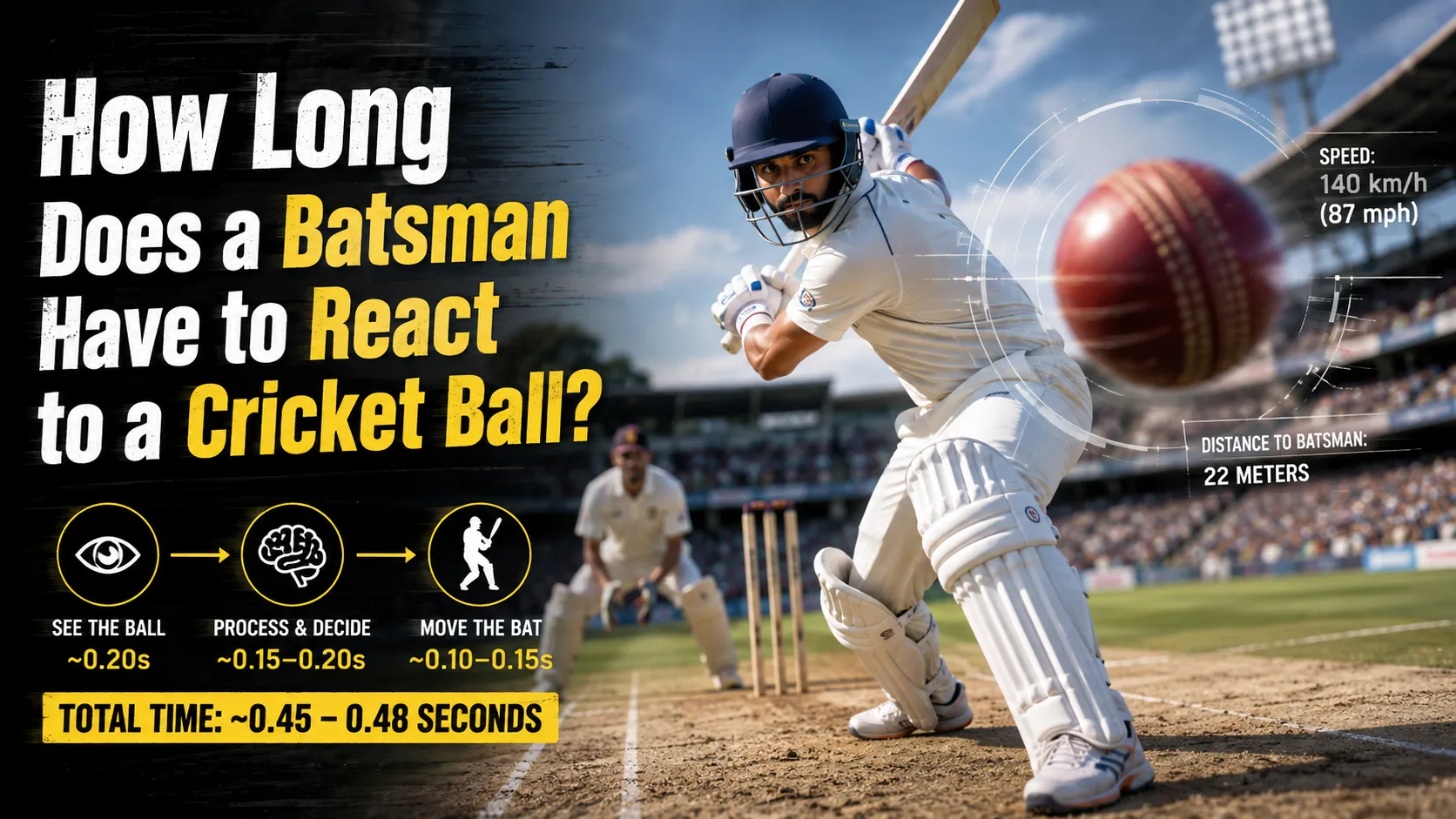
How Long Does a Batsman Have to React to a Cricket Ball?
A batsman facing a 150 km/h delivery has less than half a second for the ball to travel from the bowler toward the batter. Depending on the distance and how the calculation is made, published estimates put the available flight time at roughly 0.42–0.48 seconds. At 160 km/h, that falls to roughly 0.40–0.45 seconds.
But the important question is not simply how fast a batsman can react.
Elite batting works because the batter is not starting from zero information when the ball leaves the bowler's hand. Skilled batters use cues from the bowler's action, release, ball flight, pitch conditions, field setting and previous deliveries to anticipate what is coming. Research has repeatedly shown that expert cricket batters can use information available before and during the ball's flight to improve their response.
That is why a 150 km/h delivery is possible to face despite giving a batter less than half a second of physical ball-flight time.
How much time does a batsman actually have?
The simplest calculation is:
Time = Distance ÷ Speed
A cricket pitch is 22 yards long, or 20.12 metres, but the ball does not travel the entire pitch from the exact moment it leaves the bowler's hand to the instant it reaches the bat. The effective distance depends on the release point, where the ball pitches and where the batter makes contact.
That is why different studies and explanations can produce slightly different numbers.
A 2025 study modelling fast and spin bowling calculated approximately 0.424 seconds of trajectory time for a 150 km/h delivery over a 17.68-metre distance. The same model produced approximately 0.398 seconds at 160 km/h.
An earlier University of Sydney analysis, reported by ABC, used a different distance and estimated approximately 0.48 seconds at 150 km/h and 0.45 seconds at 160 km/h.
So there isn't one magic number that applies to every delivery.
Approximate ball-flight time at different speeds
| Bowling speed | Approximate time over 17.68 m |
|---|---|
| 120 km/h | 0.53 seconds |
| 130 km/h | 0.49 seconds |
| 140 km/h | 0.46 seconds |
| 150 km/h | 0.42 seconds |
| 160 km/h | 0.40 seconds |
These figures are theoretical travel times based on speed and distance; a real delivery is more complicated because the ball slows after pitching and can move through the air or off the pitch.
Why "0.4 seconds to react" is misleading
Saying that a batsman has 0.4 seconds to "react" makes the process sound like this:
Ball appears → brain reacts → shot happens
That isn't how elite batting works.
The batter is already watching the bowler before release. The brain can extract useful information from:
- the bowler's approach and rhythm
- bowling arm and release action
- wrist and hand position
- release point
- seam orientation
- field placement
- previous deliveries
- expected line and length
Research on elite batsmen has found that highly skilled players can use earlier information from the bowler's action to anticipate the type and length of a delivery. In one study, highly skilled batsmen demonstrated an ability to pick up early cues, particularly information from the bowling hand and arm, that less-skilled players did not use as effectively.
That means the batter doesn't necessarily wait for the ball to leave the hand before beginning the decision-making process.
What is perception time?
You may have seen the claim that a batter needs approximately 0.2 seconds to perceive the incoming ball.
That figure comes from research discussed in an analysis of fast bowling by University of Sydney researchers. At 150 km/h, the study described approximately 0.48 seconds of total travel time and approximately 0.2 seconds of perception time, leaving about 0.28 seconds for subsequent decision-making and movement under that particular model.
However, this should not be interpreted as a universal rule saying:
Every batsman loses exactly 0.2 seconds before they can react.
Modern research paints a more complicated picture.
Batters continuously extract information throughout the delivery. Eye-movement research has shown that skilled batsmen use predictive eye movements to anticipate where the ball will bounce and where it will arrive at the bat. They can also continue using visual information after the bounce.
So "perception time" is useful for explaining the challenge, but it is not a simple countdown that can be subtracted from every delivery.
How fast is a 150 km/h cricket ball?
A delivery travelling at 150 km/h is moving at approximately:
41.7 metres per second
At 160 km/h, it is moving at approximately:
44.4 metres per second
That means a ball travelling at 150 km/h covers roughly 4.17 metres every 0.1 seconds.
At 160 km/h, it covers roughly 4.44 metres every 0.1 seconds.
The difference seems small, but when the entire delivery lasts less than half a second, every few hundredths of a second matter.
Why does 10 km/h make such a difference?
Consider two deliveries over the same distance:
150 km/h → about 0.424 seconds
160 km/h → about 0.398 seconds
The difference is only around 0.026 seconds, or 26 milliseconds.
That sounds insignificant.
It isn't.
A batter is already working within an extremely compressed time window. The extra speed removes another small portion of the available time for reading the delivery, selecting a response and completing the movement.
Research on cricket batting describes the sport as having extremely tight temporal constraints, with successful interception requiring very precise timing. One review notes that at around 160 km/h, the temporal margin for successful contact can be only a few milliseconds.
Do batsmen actually watch the ball all the way to the bat?
Yes but not in the simple way people often imagine.
Older explanations sometimes claim that the ball moves too quickly for a batter to track visually all the way from the bowler's hand to the bat.
Research involving elite cricket batters found a more interesting picture.
Elite batsmen use distinctive eye and head-movement strategies to predict where the ball will bounce and where it will reach the bat. Rather than continuously tracking the ball with perfectly smooth eye movement, they use predictive eye movements to position their gaze where important information is expected to appear.
Another study found that batsmen's eye movements help them judge the timing and location of the ball, with visual information being used around the release, bounce and final part of the trajectory.
So elite batting is not simply:
"Watch the ball → react."
It is closer to:
"Read the bowler → predict → track key information → adjust → intercept."
How do batsmen know where the ball will go?
They don't know with certainty.
They make increasingly accurate predictions.
Before release, a batter can use information about the bowler's action and the tactical situation. Once the ball is released, its initial trajectory provides more information. As it approaches the pitch, the batter can refine the prediction of its length and line. After the bounce, the remaining trajectory becomes even more informative — but the amount of time left is extremely small.
This is why elite batters develop anticipation rather than relying purely on raw reflexes.
Research comparing cricket batsmen of different skill levels has found that highly skilled players are better at using information available before release and during the ball's flight to judge deliveries and make successful contact.
Why fast bowling is so difficult
A fast delivery creates several problems simultaneously.
1. Less time
Higher speed means shorter flight time.
2. Less time to identify length
A batter needs to determine whether the ball is likely to be a yorker, full delivery, good-length ball, short ball or another length.
3. Movement can change the prediction
Swing and seam movement can alter the ball's path.
4. Bounce creates another uncertainty
The ball can change direction and speed after pitching.
5. The shot must be physically executed
Choosing the correct shot isn't enough. The batter still has to move the feet, position the body and bring the bat into the correct place at the correct moment.
That is why cricket batting is both a perceptual and physical skill rather than simply a test of reaction speed. Research describes elite batting as a complex perceptual-motor task requiring rapid decision-making under severe time constraints.
Why elite batsmen don't rely only on reflexes
Suppose a batter waited until the ball had completely revealed its line and length before deciding what to do.
Against genuine pace, there simply isn't enough time to make every decision from scratch.
Instead, experienced batters reduce the amount of uncertainty before and during the delivery.
They already know:
- The bowler's likely options
- The field setting
- The bowler's preferred line
- The previous delivery
- The match situation
- Their own scoring options
- What lengths are likely from that release point
The brain is therefore making predictions continuously.
This is one reason experienced batters can appear to "see the ball better" even though their basic human reaction speed is not magically different from everyone else's.
Their advantage is largely in anticipation, information processing, pattern recognition and movement preparation.
What happens against a 160 km/h delivery?
At 160 km/h, the ball is travelling at approximately 44.4 metres per second.
Using a 17.68-metre calculation distance:
17.68 ÷ 44.4 ≈ 0.40 seconds
So the entire calculated trajectory is only about 400 milliseconds.
That is not 400 milliseconds of pure reaction time.
It includes the entire sequence:
ball release → visual information → prediction → decision → movement → bat-ball contact
And some of the most important information is available before the batter has to make the final movement.
That is why the world's fastest bowlers create such a severe problem even for elite batters.
Why a slower ball can be harder to hit
This is where cricket becomes even more interesting.
A slower delivery gives the batter more physical flight time, but that does not automatically make it easier to hit.
A batter who has committed to a fast delivery can begin the movement too early if the ball is significantly slower.
The challenge is therefore not simply:
"How fast is the ball?"
It is:
"How accurately can the batter predict when and where the ball will arrive?"
This is one reason changes of pace are effective. The bowler manipulates the batter's expectation of timing.
Reaction time vs decision time vs movement time
These terms should not be treated as interchangeable.
Reaction time
The time between detecting a stimulus and initiating a response.
Decision time
The time required to determine what response to make.
Movement time
The time required to physically execute the chosen movement.
Anticipation
Using information available before the final event to predict what is going to happen.
In cricket, these processes overlap.
A batter may begin preparing for a shot before the ball has completed its flight because earlier information has already changed the probability of what is coming.
That is why measuring batting performance using ordinary laboratory reaction-time tests alone misses a major part of the skill involved.
How much time does a batsman have at different speeds?
Here is a useful simplified comparison using the 17.68-metre calculation distance used in the 2025 modelling study:
| Bowling speed | Speed in m/s | Approx. trajectory time |
|---|---|---|
| 120 km/h | 33.3 m/s | 0.53 s |
| 130 km/h | 36.1 m/s | 0.49 s |
| 140 km/h | 38.9 m/s | 0.46 s |
| 150 km/h | 41.7 m/s | 0.42 s |
| 155 km/h | 43.1 m/s | 0.41 s |
| 160 km/h | 44.4 m/s | 0.40 s |
These are calculated trajectory times, not guaranteed human reaction times. Actual batting conditions are affected by release point, pitching distance, ball movement, bounce, speed loss and the batter's position.
So, how long does a batsman really have to react?
There isn't one universal number.
For a fast delivery around 150 km/h, the ball can reach the batter in roughly 0.42–0.48 seconds, depending on the distance used in the calculation.
At 160 km/h, that can fall to roughly 0.40–0.45 seconds.
But calling all of that "reaction time" is misleading.
The batter is simultaneously:
- Receiving visual information
- Using information from the bowler's action,
- Predicting the ball's line and length,
- Deciding what response is appropriate,
- Moving into position
- And timing the bat to meet the ball.
Elite batsmen succeed because they anticipate and prepare rather than waiting for the ball to arrive before reacting.
That is the real reason a human being can face a 150–160 km/h cricket ball.
The real secret isn't superhuman reflexes
The most impressive part of elite batting isn't that a batsman can somehow override the limits of human reaction speed.
It is that the batter doesn't need to.
The bowler gives away information before the ball reaches the bat. The batter learns to recognise that information earlier, predict the likely delivery and prepare the appropriate movement.
Research on cricket batting consistently points toward this combination of anticipation, visual information processing, decision-making and precise motor control as a defining feature of expertise.
So the next time a 150 km/h delivery appears to be hit effortlessly, the important number isn't simply 0.42 seconds.
The real story is what the batter has already understood before those 0.42 seconds are over.
Frequently Asked Questions
How much time does a batsman have to react to a 150 km/h ball?
The ball's calculated trajectory time can be roughly 0.42–0.48 seconds, depending on the distance and calculation method. That is the total flight window, not pure human reaction time.
How much time does a batsman have to react to a 160 km/h ball?
Using a 17.68-metre calculation distance, a 160 km/h delivery takes approximately 0.40 seconds. Other calculations using different effective distances produce figures closer to 0.45 seconds.
Can a human react to a 150 km/h cricket ball?
Yes, but elite batting is not based on simple reaction speed alone. Batters use anticipation, visual cues, previous deliveries, field placement and information from the bowler's action to prepare before the ball reaches them.
What is perception time in cricket batting?
Perception time describes the period needed to visually detect and process important information about an incoming delivery. A frequently cited estimate is around 0.2 seconds, but it should not be treated as a fixed amount that every batter loses on every delivery. Cricket batting involves continuous information processing and anticipation.
Do batsmen react after the ball is released?
Partly, but they also use information before release. Research has shown that highly skilled batsmen can extract advance information from the bowler's action and use it to anticipate the delivery.
Why can professional batsmen face 150 km/h bowling?
Because they don't wait until the ball reaches them to begin making decisions. Years of practice allow them to recognise patterns, use advance cues, anticipate likely deliveries and coordinate their movements under severe time constraints.
Does a faster cricket ball always mean a shorter reaction time?
It means less physical flight time, assuming the same effective distance. But the actual difficulty of a delivery also depends on swing, seam movement, bounce, release point, angle, pitch conditions and whether the batter can anticipate it.
Why does a slower ball sometimes deceive a batsman?
A slower delivery changes the expected timing. If the batter prepares for a faster ball, the bat or body movement can begin too early, causing mistimed contact. This is a timing and anticipation problem, not simply a lack of reaction speed.