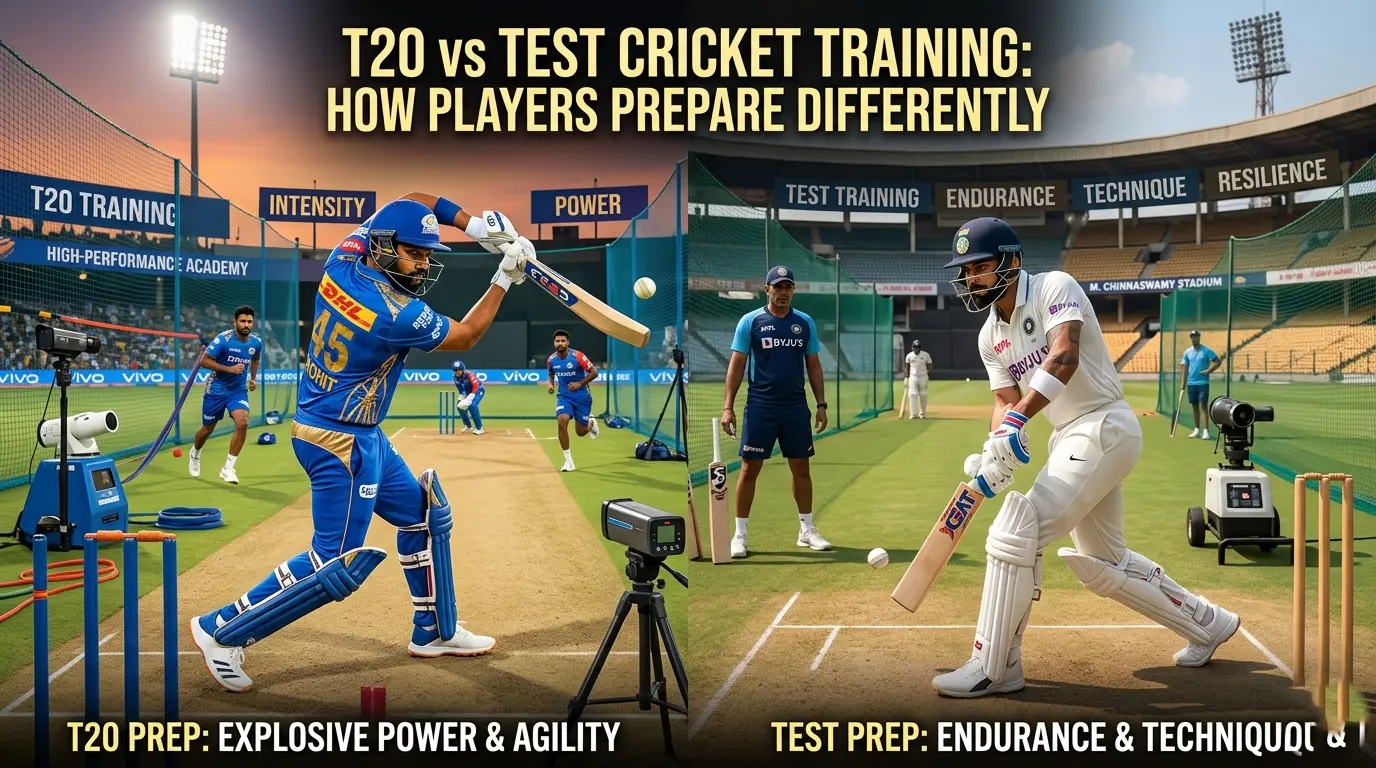
Test vs T20 Captaincy in Cricket: How Leadership Changes Completely Across Formats
The captain sets the field, manages the bowling attack, reads the pitch, handles the pressure, and makes the decisions that determine whether a team wins or loses. That description applies equally to Test cricket and T20 cricket. Almost everything else about the captain's job is different between the two formats.
Test captaincy and T20 captaincy demand different thinking speeds, different strategic time horizons, different relationships with bowlers and batters, and different psychological approaches to match situations. A captain who excels in one format but struggles in another is not failing at leadership — they are applying the wrong type of leadership to the wrong environment. Understanding how captaincy changes across formats reveals one of cricket's most sophisticated and underappreciated dimensions.
Test Captaincy: The Long Game
A Test match gives a captain five days and potentially 200 overs of bowling to work with. That time horizon fundamentally shapes every decision — because in Test cricket the consequences of any single decision unfold slowly, and a captain who understands this uses time as a strategic weapon rather than feeling pressured by it.
Patience is the defining quality of exceptional Test captaincy. A Test captain who reacts to every development with immediate counter-action burns through their bowling resources, disrupts rhythm across their attack, and telegraphs anxiety to both their own players and the opposition. The most effective Test captains project calm deliberateness — making changes when the evidence clearly supports them, not when the pressure of the moment makes change feel necessary.
Setting a field in Test cricket is a multi-layered decision with consequences that extend far beyond the next delivery. A slip cordon maintained for fifteen overs without a catch signals to the batting side that the captain believes the bowling is consistently threatening the edge — which is itself psychological pressure regardless of whether the catch actually arrives. A deep square leg placed precisely for a specific batter's favourite pull shot is a message that the captain has done their homework. Field placements in Test cricket communicate intent across sessions and create cumulative pressure rather than reacting to individual deliveries.
Managing bowling resources across a full Test day is perhaps the most demanding sustained leadership challenge in cricket. A fast bowler who has completed a productive morning spell needs rest before their next contribution. A spinner who is beating the outside edge repeatedly on a deteriorating pitch needs to be protected from being taken off too soon simply because they have not yet taken a wicket. A bowler who is going for runs on a flat pitch needs to be managed carefully — given enough time to find their rhythm without being left on so long that they lose confidence. Reading all of these situations simultaneously across a full day's play requires deep cricket knowledge and calm situational awareness.
Declarations represent the most uniquely Test-specific and strategically complex decision a captain makes. Declaring — choosing to end your team's innings before all wickets have fallen — is a calculated risk that trades potential additional runs for additional bowling time. Get it right and you give your bowlers enough overs to win the match. Declare too early and the opposition's target is achievable. Declare too late and there are not enough overs left to force a result. The variables involved — lead size, pitch deterioration rate, opposition batting depth, weather forecast, and remaining match time — must all be weighed simultaneously. The declaration decision is the purest expression of a Test captain's strategic intelligence.
The follow-on — requiring the opposition to bat again immediately after falling significantly short in their first innings — is equally complex. Enforcing the follow-on saves batting but exhausts the bowling attack. Declining it allows the bowling attack to rest but invites a partnership that could make the target unreachable. The decision depends on reading the current state of the pitch, the condition and fatigue of the bowling attack, and the psychological state of both sides — variables that require deep match awareness to assess correctly.
Psychological management across five days is the dimension of Test captaincy that receives least attention but matters enormously. Keeping a team motivated and focused during a slow period where wickets are not falling requires different skills from lifting a team after a batting collapse. Managing the personal dynamics of a squad that spends three weeks together in close proximity across a Test series requires emotional intelligence that tactical cricket knowledge alone does not provide.
T20 Captaincy: Decisions at Speed
T20 cricket compresses the entire strategic and tactical landscape of a cricket match into 120 deliveries per team. Every decision that a Test captain might have twenty minutes to consider, a T20 captain has twenty seconds to make. The entire cognitive and temperamental profile required for effective captaincy shifts accordingly.
Instinctive decision-making replaces deliberate strategic thinking as the primary captaincy skill in T20 cricket. A captain who needs to think through every bowling change, every field adjustment, and every batting order decision analytically before acting will consistently be too slow for the pace at which T20 matches develop. The best T20 captains have internalised their decision frameworks so thoroughly that the right response to specific match situations arrives instinctively — freeing their conscious attention for reading the match situation rather than working through the decision itself.
Powerplay management is the first critical captaincy test in a T20 match. The opening six overs — when only two fielders can be positioned outside the 30-yard circle — are disproportionately influential on the overall match result. A bowling captain who takes two early wickets in the powerplay fundamentally changes the match dynamic. A batting captain whose team scores 60-plus in the powerplay without losing a wicket creates a platform that is extremely difficult to defend against. The decisions made in these six overs — which bowlers open, how attacking the field is, how the captain responds to a batter going after their opening bowling — set the match's trajectory.
Field placement in T20 cricket is a constant, rapid tactical conversation between the captain, the bowler, and the match situation. Unlike Test cricket where fields are set and maintained across long spells, T20 fields shift delivery by delivery in response to the batter's positioning, the bowler's plan for the next ball, and the specific run-rate equation at that moment in the innings. A captain who is not reading each batter's intentions and adjusting accordingly is conceding field placement advantages that skilled batting units will immediately exploit.
Bowling rotation in T20 cricket requires managing a constraint that Test captaincy does not face — each bowler can bowl a maximum of four overs. This constraint means the captain must plan their bowling allocation across the full 20 overs from the match's beginning, not simply use their best bowler when conditions favour them. Saving a specific bowler for the death overs, protecting an expensive but skillful bowler by keeping their remaining overs in reserve, and deciding when to use a part-time bowling option to save specialist overs for more important phases — these resource allocation decisions are continuous across every T20 innings.
Death over captaincy — managing the final four to six overs of an innings — is where T20 matches are most commonly won or lost, and where captaincy decisions have the highest individual match impact. A captain who has their best death bowling specialist available with overs remaining, fields set intelligently to cut off the hitting zones that the batter has used throughout the innings, and the composure to back their bowler's plan rather than making reactive changes under pressure is giving their team the optimal chance of defending any target.
Batting order flexibility is a tactical dimension unique to T20 captaincy that Test captains rarely exercise. Sending a specific batter up the order to exploit a matchup advantage — a left-hander against a right-arm bowler angling into them, or an aggressive strokeplayer against an inexperienced bowler — is a standard T20 tactical option. Pinch-hitters used to maximise the powerplay before settling players take over represent another common variation. The flexibility to treat the batting order as a tactical variable rather than a fixed sequence requires trust in the players involved and the confidence to deviate from convention when the match situation rewards it.
Momentum management separates the most effective T20 captains from merely competent ones. T20 matches swing between teams rapidly and repeatedly. A captain who correctly identifies when their side has seized momentum and reinforces it — maintaining an attacking field rather than protecting a lead defensively — extracts more value from positive passages than one who defaults to caution. Equally, a captain who correctly identifies when the opposition has seized momentum and acts decisively to disrupt it — a bowling change, an aggressive field shift, a direct conversation with a bowler who needs to recalibrate — limits the damage from difficult periods more effectively than one who waits for momentum to shift naturally.
What Makes a Captain Exceptional Across Both Formats
The core leadership qualities that make a captain effective are the same across both formats — clear communication, the ability to inspire confidence in teammates, composure under pressure, and the willingness to make difficult decisions when circumstances demand them.
What changes is how those qualities are expressed. Composure in Test cricket looks like patience and deliberate calm across five days of constant decision-making. Composure in T20 cricket looks like confident instinctive decisiveness across three hours of rapid-fire situations. Both are genuine composure — but they feel completely different and require different training and experience to develop.
The captains who have been genuinely exceptional across both formats — players like MS Dhoni, whose calm under pressure expressed itself identically whether finishing a T20 chase in the final over or quietly suffocating an opposition batting lineup across a Test day — possess an unusual psychological profile that adapts the same core temperament to the specific demands of each format. They are not doing something different in each format. They are expressing the same underlying leadership through the specific language each format speaks.
FAQ: Test vs T20 Captaincy in Cricket
What is the main difference between Test and T20 captaincy? Test captaincy emphasises long-term strategic thinking, patient resource management, and decisions that play out across five days. T20 captaincy demands instant instinctive decisions, aggressive tactical adjustments, and managing a match that can change completely within a single over.
Why is declaration an important Test captaincy decision? A declaration — ending your innings before all wickets fall — trades potential additional runs for additional bowling time. Getting the timing right requires weighing the lead size, pitch deterioration, bowling attack condition, weather, and remaining match time simultaneously. It is the most complex strategic decision unique to Test cricket.
How do T20 captains manage their bowling attack? T20 captains must plan bowling allocations across all 20 overs from the match's beginning, balancing powerplay bowling, middle-over containment, and death over specialists within each bowler's four-over maximum. Saving the right bowlers for the right phases is central to T20 bowling management.
What are death overs in cricket and why do they matter for captaincy? Death overs are the final four to six overs of a T20 innings when batting teams attempt to maximise their score. Captaincy decisions in this phase — which bowlers to use, how aggressively to field, and how to back bowlers under pressure — have the highest individual impact on T20 match results.
Can the same captain be effective in both Test and T20 cricket? Yes, though it requires significant adaptability. The core qualities of effective leadership transfer across formats but must be expressed differently. Captains who succeed in both formats typically possess strong instinctive cricket intelligence combined with the temperamental flexibility to shift between deliberate long-form strategic thinking and rapid short-form tactical decision-making.